

BOOKZONE
Hands-On Large Language Models (Full Colour Edition) (Bestseller)
Author : Jay Alammar
Binding:Paperback
Publication Date 2024
Publisher :
SKU:9789355425522
Select Your Gift
Gift Message (Optional)
Bulk Discount Get Exta 5% upto 10%
Share
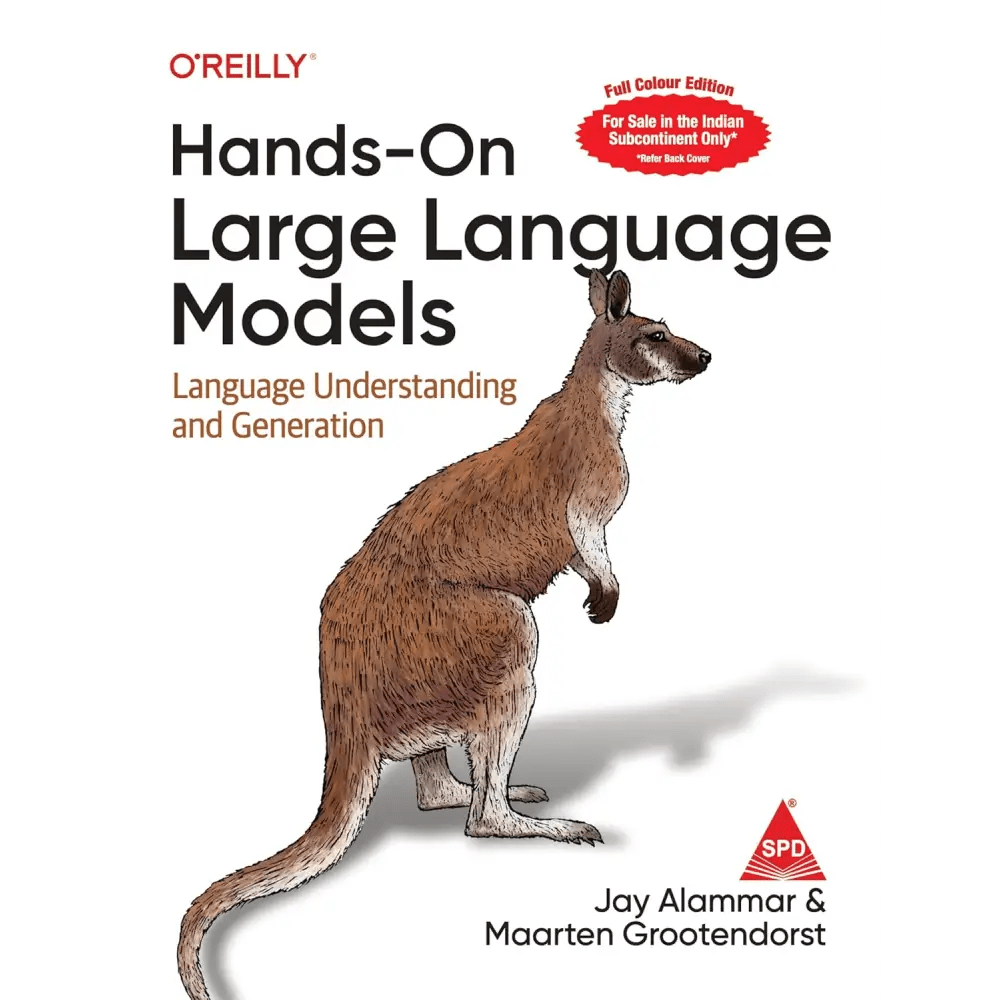
AI has acquired startling new language capabilities in just the past few years. Driven rapid advances in deep learning, language AI systems are able to write and understand text better than ever before. This trend is enabling new features, products, and entire industries. Through this book's visually educational nature, readers will learn practical tools and concepts they need to use these capabilities today.You'll understand how to use pre-trained large language models for use cases like copy writing and summarisation; create semantic search systems that go beyond keyword matching; and use existing libraries and pre-trained models for text classification, search, and clusterings. This book also helps you:
Understand the architecture of Transformer language models that excel at text generation and representation
Build advanced LLM pipelines to cluster text documents and explore the topics they cover
Build semantic search engines that go beyond keyword search, using methods like dense retrieval and rerankers
Explore how generative models can be used, from prompt engineering all the way to retrieval-augmented generation
Gain a deeper understanding of how to train LLMs and optimize them for specific applications using generative model fine-tuning, contrastive fine-tuning, and in-context learning
About the Author Jay Alammar is Director and Engineering Fellow at Cohere (pioneering provider of large language models as an API). In this role, he advises and educates enterprises and the developer community on using language models for practical use cases). Through his popular AI/ML blog, Jay has helped millions of researchers and engineers visually understand machine learning tools and concepts from the basic (ending up in the documentation of packages like NumPy and pandas) to the cutting-edge (Transformers, BERT, GPT-3, Stable Diffusion). Jay is also a co-creator of popular machine learning and natural language processing courses on Deeplearning.ai and Udacity.Maarten Grootendorst is a Senior Clinical Data Scientist at IKNL (Netherlands Comprehensive Cancer Organization). He holds master's degrees in organizational psychology, clinical psychology, and data science which he leverages to communicate complex Machine Learning concepts to a wide audience. With his popular blogs, he has reached millions of readers explaining the fundamentals of Artificial Intelligence--often from a psychological point of view. He is the author and maintainer of several open-source packages that rely on the strength of Large Language Models, such as BERTopic, PolyFuzz, and KeyBERT. His packages are downloaded millions of times and used data professionals and organizations worldwide.Table of ContentsPart I. Understanding Language Models1.An Introduction to Large Language Models2.Tokens and Embeddings3.Looking Inside Large Language ModelsPart II. Using Pretrained Language Models4.Text Classification5.Text Clustering and Topic Modeling6.Prompt Engineering7.Advanced Text Generation Techniques and Tools8.Semantic Search and Retrieval-Augmented Generation9.Multimodal Large Language ModelsPart III. Training and Fine-Tuning Language Models10.Creating Text Embedding Models11.Fine-Tuning Representation Models for Classification12.Fine-Tuning Generation Models